







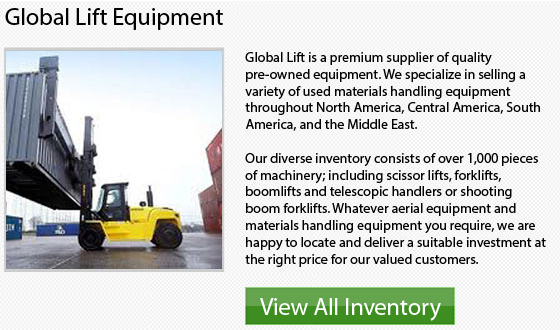
Counterbalance forklifts are essentially lift trucks which are designed with counterweight at the back of the machine. The counterweight works to balance the weight which the tines are carrying at the front of the load. This design is engineered to stabilize conventional lift trucks. When it comes to electric counterbalance lift trucks, the battery itself forms the counterweight.
Nearly every forklift manufacturer would have in their product range, a counterbalance forklift. These machines would come in a huge assortment of fuel sources, sizes and configurations. These lift trucks can be fitted. They can operate in various applications. These kinds of lift trucks are equipped with a variety of accessories. Common options and attachments consist of: fork shifts, slip sheet attachments, side shifts and hydraulic clamps just to name some items.
Counterbalance lift trucks have changed the material handling business. They have become the cornerstone of storage and distribution systems where they perform loading, stacking, horizontal transport functions and unloading. The standard warehouse lift trucks are typically utilized for lift heights under 20 feet or 6 meters. There have been some recently developed units which can lift to heights 31 feet or 9.5 meters. The smaller 1-1.8 ton or 4000 pound forklifts are the main workhorses in the majority of warehouses. These are the most popular models which most small businesses would have. The average warehouse counterbalance forklift is a wide-aisle truck which needs roughly 3 meters or 11 feet to turn in.
Also, the counterbalanced forklift is not necessarily limited to warehouse environments. They are often utilized for container carrying and heavy use together with basically every use in between. Counterbalance lift trucks are the most versatile and widely used of all materials handling machinery.
Because of their durability and versatility, counterbalance forklifts are commonplace in a large array of working environments, like warehousing, production and retail. Some of the industrial use include: automotive, timber, food and chemical businesses.